
The NEX books
NEX — Distributed Linux, architecture and programming is a technical handbook with labs, in four volumes, by Roberto Arato. It follows NEX from the idea to a working cluster, and then goes deep into the file system, administration and development. Every chapter ends with a lab to follow step by step on your own cluster: the NEX Live USB stick or the ready-made virtual machines are enough.
The books come in English and in Italian, as a paperback (7 × 10 in) and as a Kindle ebook. The text follows NEX 1.0 beta 5.
Volume I · The basics
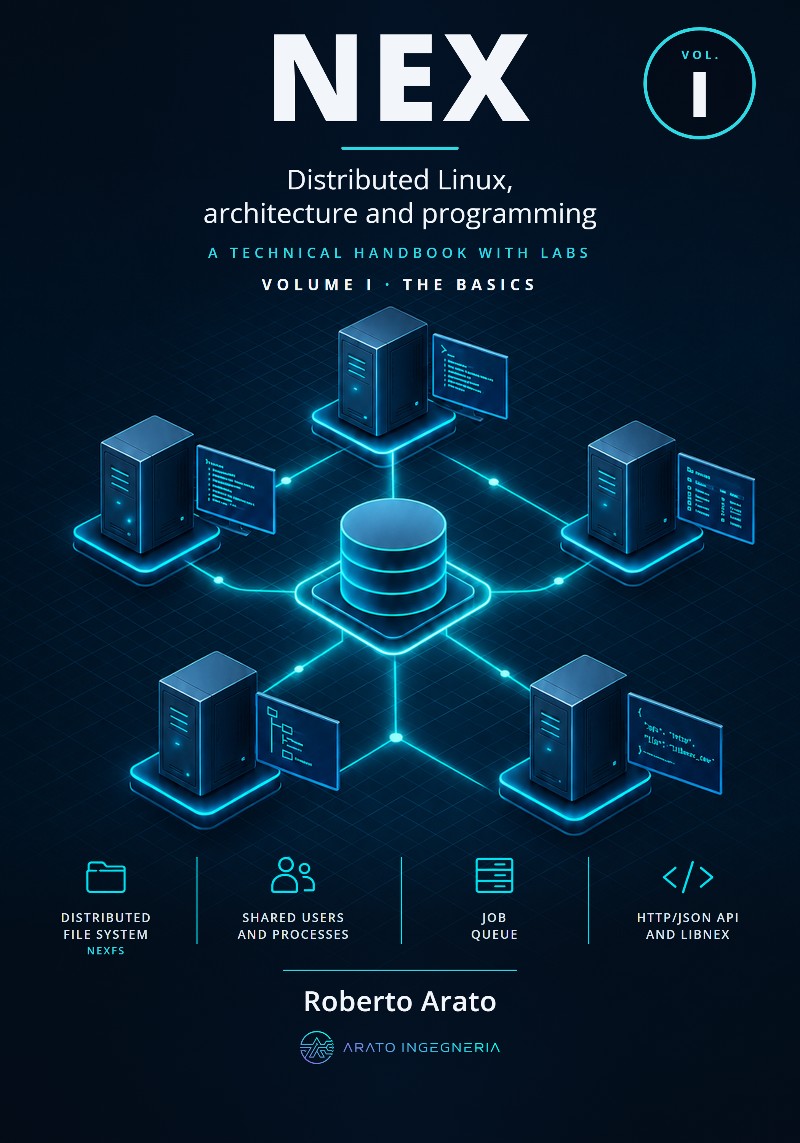
Volume I · The basics Coming soon
For Linux administrators, programmers and users who want to go from the idea to a working cluster.
nex-cluster joins several Linux nodes into a system you use like a single machine: one shared folder, the same users, a single process table. This first volume takes you from the idea to a working cluster: how it is built, how to install it with the NEX Live USB stick, with ready-made images or on real machines, and how to work on it every day with nexsh, jobs, the queue and shared devices. Every chapter ends with a lab to follow step by step.
Contents
- I.1 Many machines, one computer
- I.2 How a NEX cluster is built
- I.3 Where a program runs: terminal, windows, audio, signals
- I.4 Users, processes, resources and communication
- I.5 Preparing a lab: USB stick, ready-made images or real machines
- I.6 The first node
- I.7 The other nodes, the three copies of the data, the first user
- I.8 nexsh and the cluster commands
- I.9 Jobs, the queue, scheduled tasks and
nex make - I.10 Devices, cluster ports and the shared clipboard
- Command quick reference
- Appendix A. The NEX commands and the manual pages
- Appendix B. Configuration files and logs
- Glossary
Volume II · NEXFS
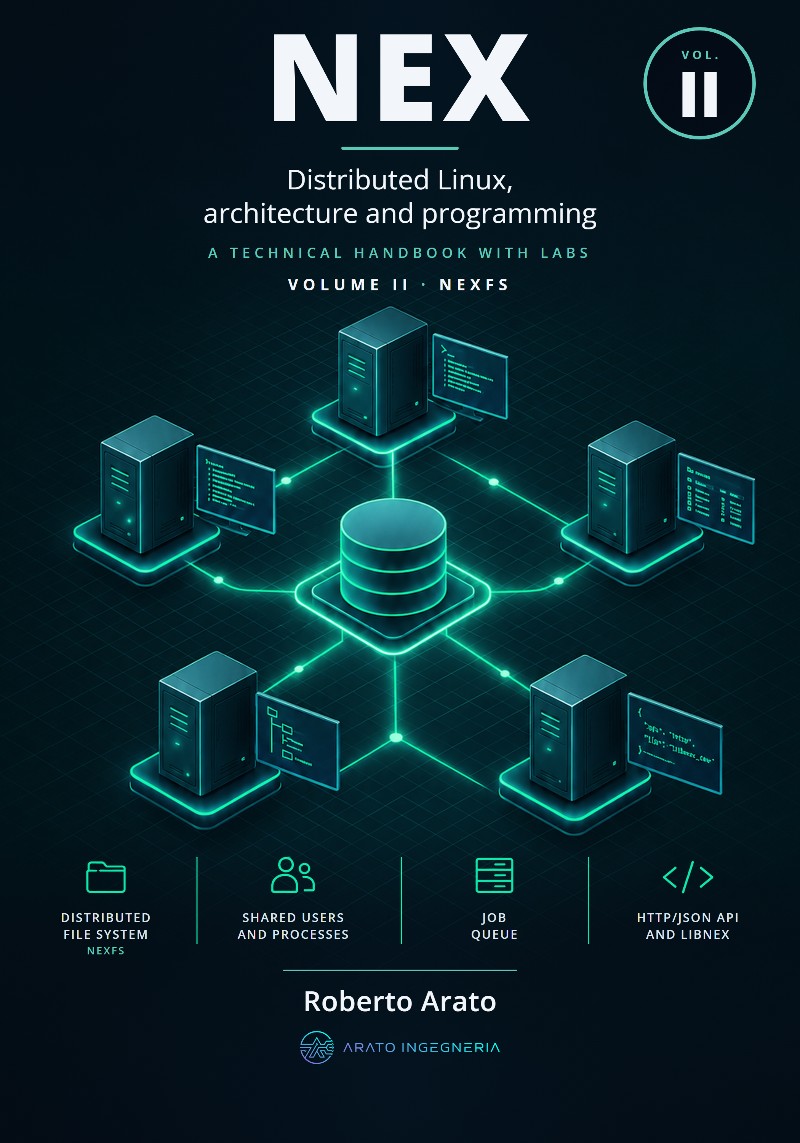
Volume II · NEXFS Coming soon
For anyone who wants to know the cluster's file system in depth: administrators who run it, programmers who write to it, people who need to trust their data to it.
This second volume goes deep into NEXFS, NEX's distributed file system: how it keeps the data, how it behaves with programs, how it is protected and how it is maintained. Permissions, locks, atomic rename and fsync work across nodes as on a local disk; the copies of every block live on different nodes and are rebuilt on their own; snapshots, quotas, TLS and encryption protect the work. It builds on Volume I and reviews it in its opening pages.
Contents
- Before you start: what you need from Volume I
- II.1 The goals and the model of NEXFS
- II.2 A real POSIX file system
- II.3 Copies, data durability and growing live
- II.4 Snapshots, quotas and the key-value store
- II.5 Security: TLS, roles, encryption, scrub
- II.6 NEXFS maintenance and diagnostics
- Command quick reference
- Appendix A. The NEX commands and the manual pages
- Appendix B. Configuration files and logs
- Glossary
Volume III · Administration
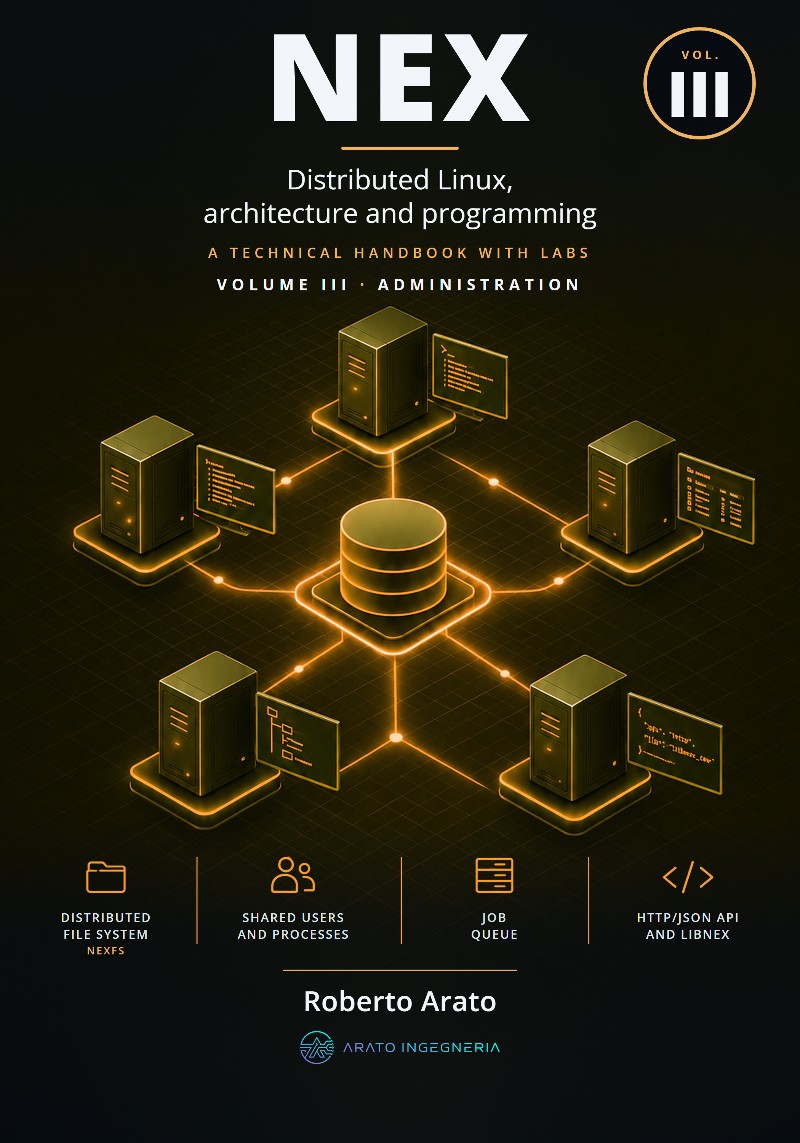
Volume III · Administration Coming soon
For administrators and IT managers who keep the cluster running every day.
This third volume walks with those who keep the cluster running every day, from the services that must stay up to the bad days. Always-on programs with virtual addresses that follow them, shared folders for Windows and Mac, upgrades one node at a time without stopping the cluster, alarms, audit, backup and restore. It closes with three real settings: the engineering office, the computing lab and the machine room.
Contents
- Before you start: what you need from Volume I
- III.1 Cluster services and virtual IPs
- III.2 Upgrades without stopping
- III.3 Monitoring, alarms, accounting and audit
- III.4 Backup, restore and operating procedures
- III.5 When something goes wrong
- III.6 Engineering office, computing lab, machine room
- Command quick reference
- Appendix A. The NEX commands and the manual pages
- Appendix B. Configuration files and logs
- Glossary
Volume IV · Development
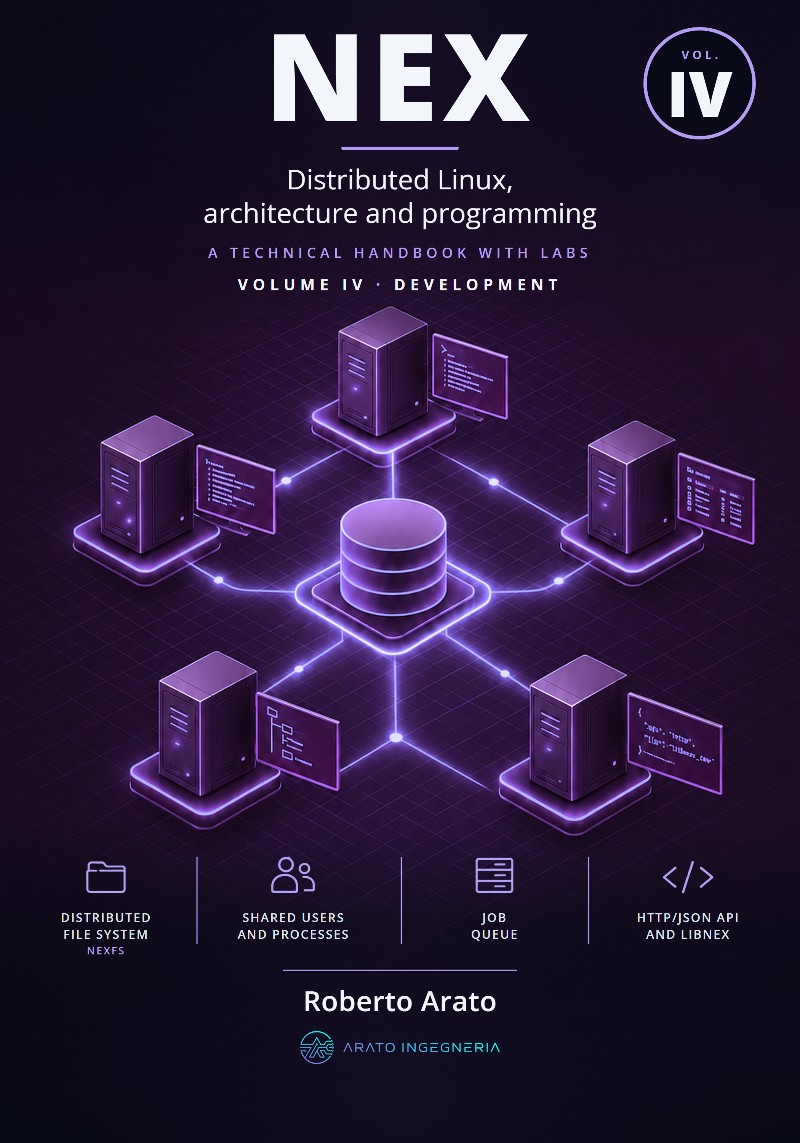
Volume IV · Development Coming soon
For programmers who write for the cluster, in any language, and those who bring an existing Linux application to it.
This fourth volume is for those who program the cluster, from any language and any machine, and for those who bring an application they already have. The HTTP/JSON API gives cluster state and jobs with a token and an HTTPS request; libnex brings remote processes, keys, locks, queues and messages to C; Python and shell scripts use the nex commands and their JSON output. The appendices collect the API, the libnex functions, the commands and the configuration.
Contents
- Before you start: what you need from Volume I
- IV.1 The HTTP/JSON API
- IV.2 Programming in C with libnex
- IV.3 Python on the cluster
- IV.4 Shell scripts and other languages
- IV.5 Bringing an existing Linux application to the cluster
- Command quick reference
- Appendix A. The NEX commands and the manual pages
- Appendix B. Configuration files and logs
- Appendix C. HTTP/JSON API quick reference
- Appendix D. The libnex functions
- Glossary
Books and online documentation
The books tell the story in order, with labs. The online documentation is always at the latest version and is free: guides, manual pages and the command quick reference.